CONTENT WARNING: Implied slut-shaming + purity culture, and verbal mistreatment of sex workers
Parvati left the Belizaires, and picked Rukmini and Jules up.
Her family seemed tired and worn, though not to the point of a breakdown. Jules even drove them home safely.
As for the investigation itself…
Parvati looked through Mira’s folder. The young girl’s body wasn’t found. Given that the other victims’ mutilated bodies were, and that the spilled blood wasn’t even hers (it likely came from a blood bag), it was safe to assume Mira was alive.
But being alive wasn’t treated well. Parvati shuddered to think what the vampire was doing to the young girl. Being used as a blood bank for the Sovereign and being transformed into a vampire were the nicer options.
Rukmini returned the very next day. She knew the exact location Blair got his drugs from, though what good that would do in helping them hunt vampires, Parvati didn’t know.
For her part, Parvati looked into the Bluewood Museum of Vampire History. Its free day had been moved from July First to June twentieth, which was a little less than a week away; Parvati set up an appointment with the curator, and waited.
Parvati assumed Jules would act, given that Mira’s kidnapper committed the crime solely to spite her. She was dead wrong. Even Noe and Rohini’s tearful calls couldn’t rouse the once-great hunter to action.
All this brought to mind Parvati’s other grandparents. Reginald Dawns, Ram and Mohini Kalidas.
Reginald was a man of the seventies, trained to fear being outshone by a woman. But he’d run support for Jules his whole life; he was her lawyer, and handled the unmemorable, tedious aspects of the job. He took her surname upon marriage, and encouraged her in a career that would always put her above him.
Ram was an Indian civil servant. He fought corruption in a country rife with it. And he had married a sex worker — something unheard of in Desi society back then — and fiercely defended her to his friends, colleagues and family.
Mohini came from a poor shoe-shining family. She left the Maharastrian countryside to pursue education in Mumbai; she entered sex work, an intensely dangerous career, to support her dreams. She’d met Ram in her final year of college, and married him two years later. Afterward, she used her position as his wife to protect other sex workers.
Parvati tried to draw encouragement from their stories.
But theirs were tales with tragic ends: Ram and Mohini both died of stress and early heart failure. Only Reginald passed at a natural age, and nobody remembered his name.
He was not alone in that. All of them suffered the fate of being forgotten.
Perhaps that made them more heroic, because they had done good deeds, and received nothing in return.
But Parvati didn’t want to be forgotten, and, no matter how noble her failure, really wanted to win.
Her nerves were shaking when she went to meet professor and curator Albert Smokes.
…
The Museum of Vampire History was designed to look like an old European castle. Large steps led up to two wooden gates stained with fake blood. The whole thing was built with gray stone, and dotted with (dull) black spikes. A banner hung over the wooden gates, proclaiming a free day.
Inside, the Museum was packed tighter than earth over a grave. The air-conditioned cold was soon replaced with warmth from hundreds of bodies: Parvati jostled against people while in line to sign in.
The staffer, a brown-skinned woman in a turquoise hijab, greeted her with a strained smile.
“Ms. Kalidas-Dawns, we’re handing out free salt jars,” she said. She shoved one in Parvati’s hand before the younger girl could protest. “And take a pamphlet.” This, too, was stuffed into Parvati’s full arms. “You can find more info on defending against vampires at our website at the BluewoodMuseumofVampires.Edu, and the Online Association of Indiana’s Domestic Vampires.Gov.”
“Um, actually,” Parvati stammered, “I’m here to meet Professor Albert Smokes.”
The woman paused. “Did you schedule an appointment?”
Parvati hastily nodded, pulling out her phone and showing the staffer.
“I see,” said the staffer. “You volunteered here a couple years ago.” She handed Parvati a key. “You remember how to reach his office?”
Parvati nodded. The staffer waved her off, and gestured to the next person forward.
Stuffing the jar and pamphlets into her book bag, where she kept Mira’s folder, Parvati weaved through the museum’s halls.
She spotted a few exhibits. Displays presented rusted axes, jars of salt, crosses stained with dried blood. Plaques told tales of religious figures, from Indigenous medicine men, to hoodoo priests, to Jewish rabbis, and how they protected their communities from the feral undead.
The museum had been remodeled to teach Bluewood’s inhabitants how to defend against vampires.
It was the right and responsible decision, but Parvati wished they never had to do it in the first place.
The vampire Sovereign was turning her town inside out, and tearing apart the people she loved.
She ducked into a corner, behind a potted citrus. The plant shadowed a mahogany door with an employee’s only sign. Parvati drew a ragged breath before unlocking the door and slipping inside.
The lighting was dim here. A rickety stairwell led to the second story: portraits of former museum curators and famous vampire hunters lined the stairway’s walls.
Parvati was at the top of the stairwell when something caught her eye.
It was a portrait of Jules as a young woman, in the prime of her vampire-hunting prowess. The painting had distracted Parvati every time she went upstairs as a volunteer.
I thought I’d outgrow this by now, Parvati thought faintly.
But something about the portrait called to her. Maybe it was the childish delight of having a family member so important she made her way into an elaborate oil painting. Maybe it was because of how powerful Jules looked, with her bobbed hair darker than a starless night and eyes gleaming like steel blades.
Maybe it was because Jules had everything. She was the only female American vampire hunter in her generation, but became the most beloved among them. Little girls everywhere looked up to her. People trusted her, because Jules was their best defense against the monsters that haunted them well into the days of electric lighting and growling engines.
And yet, she gave it up.
Jules had been offered the chance to become the curator of the Smithsonian Institute of Vampire History.
She refused that honor, too.
And with her gone, the bloodthirsty creatures of the night were crawling out of the grave.
“You haven’t changed a bit in the last four years, have you, Parvati?”
The brisk male voice made Parvati jump.
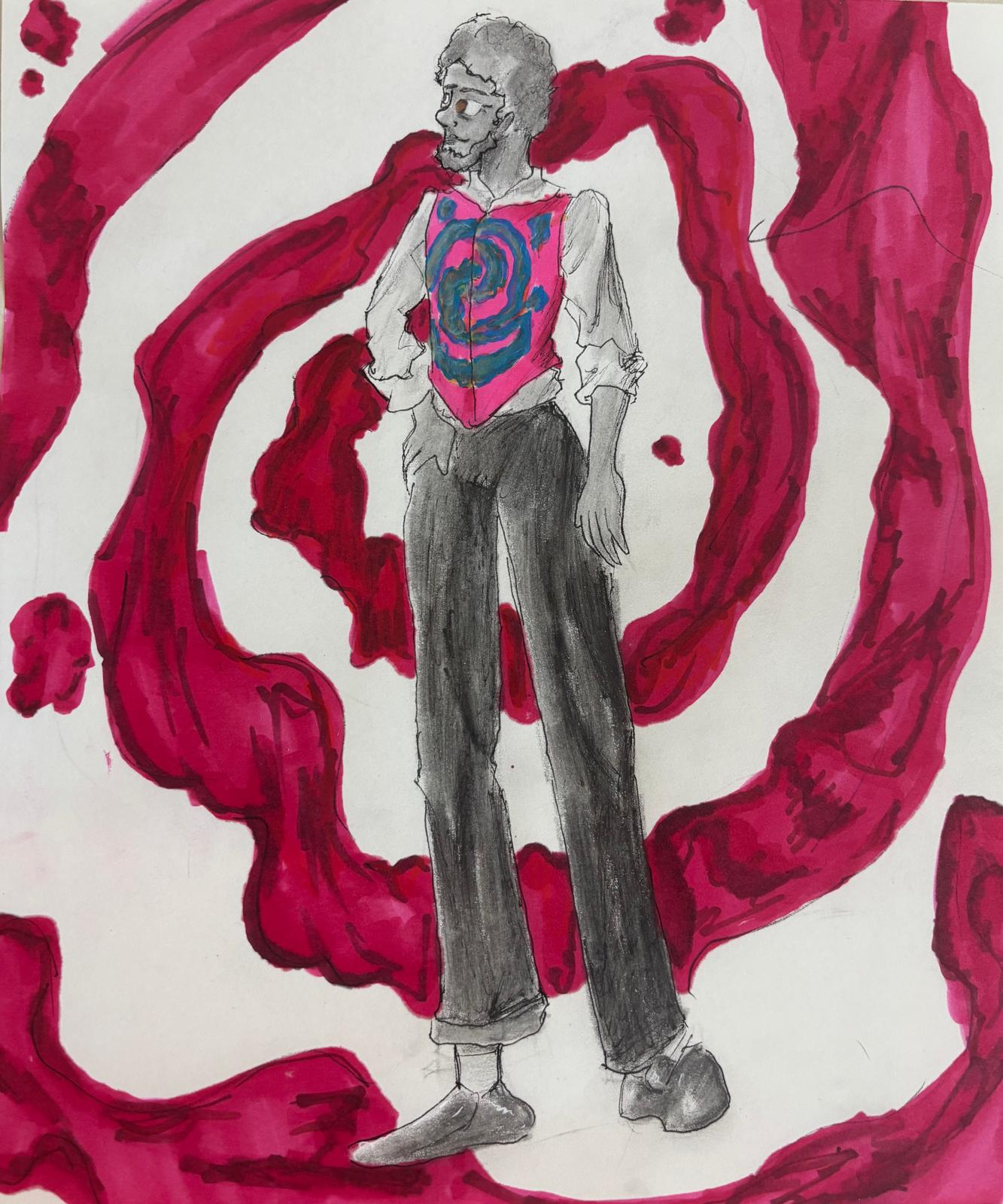
She spun around, and found a short, biracial man watching her. His curls were a bit grayer, his voice deeper than when they last met, but Parvati would recognize that goatee, and unfortunate tie-dyed vest anywhere.
“Professor Smokes! You scared me.”
“Sorry,” Professor Albert Smokes, curator of the Bluewood Museum of Vampire History, said. He nodded to Jules’ portrait. “Your grandmother’s an inspiring woman, isn’t she?”
“I guess.” Parvati fought to keep the resentment out of her voice. If Smokes’ rueful smile was any indication, it was a lost battle.
He stepped beside her, and looked thoughtfully up at the portrait.
“I called Jules twice,” he said quietly. “First, when that homeless man was killed. The second time, when that poor schoolgirl disappeared.”
“You did?” Parvati asked. “Grandma didn’t tell me.”
Smokes hmphed softly, seemingly unsurprised by the news. He gestured toward his office. “Would you like to come inside?”
Parvati nodded, so Smokes opened the door for her.
Parvati immediately realized something was off. Folders, papers, and books big enough to work as doorstoppers were scattered all over his desk. The framed photo of Smoke’s grinning wife, and that mysterious picture of a grim-looking older woman and girl, were toppled. Even the trans flag by his window (Smokes was transgender himself) was drooping.
Atop it all sat a plate of steaming mini-samosas.
“Sorry about the mess,” Smokes said, pulling up two chairs. “I’ve been working odd hours.” He and Parvati took their seats. “And —” he offered the mini-samosas — “here.”
“Thanks,” Parvati said, popping one into her mouth.
Smokes and Parvati’s history with mini-samosas stemmed from her volunteering days. Smokes would give the volunteers beef pockets, but being a nominally-practicing Hindu, Parvati couldn’t eat them.
So, Smokes bought mini-samosas for Parvati and the one vegetarian kid.
This combination of big city open-mindedness and Midwestern politeness was something Parvati appreciated about Smokes, and Bluewood in general.
Smokes leaned toward her, eyes thoughtful and sharp. “In the past week,” he said, “I have been contacted by an eclectic bunch of individuals. Multiple shopkeepers, their affiliates and two bereaved parents. They believe the officers who caught Adam Clancey are in league with a vampire. A vampire Sovereign, precisely, whom they claim is behind this town’s trouble. All the shopkeepers named Jules Dawns’ granddaughter as their source. The parents refused to reveal theirs.”
“What are you asking, Professor Smokes?”
Smoke steepled his fingers, so that his candy-colored nails caught the light.
“I trust you. I trust Jules. And I can’t see how Adam could be the only vampire, after that schoolgirl was taken. Parvati, could you explain what’s happening? From the beginning, if it isn’t too stressful?”
Relief swept through Parvati like cleansing rain. Finally, somebody important was investigating this.
She explained.
For some reason, she thought the explanation would be easy.
But every word took her back to the bloodied room, to the death-stench that infested the shop’s every corner.
When she was done, she couldn’t bring herself to look Smokes in the eye.
“Parvati?” His voice was unusually gentle. “Are you alright?”
“Fine,” she lied, stuffing a couple samosas into her mouth. They’d gone cold as she talked.
A moment of pitiful quiet ticked by. Parvati swallowed her cold samosa.
“I did ask to interview Adam,” Smokes mused. “I figured the police refused for legal reasons, and the chief would be especially stressed, but —” he sighed. “It’s a damn shame how it all turned out. But if there’s a genuine Sovereign running around —” he stopped, brows furrowing.
“Will you investigate the officers?” Parvati asked softly.
“It is my only lead,” Smokes said, voice achingly melancholy.
Parvati looked up. “No, it isn’t. When that vampire took Mira — the kidnapped schoolgirl — it left a note.” She cleared her throat and quoted. “Jules Dawns. The Belizairie girl is gone because of you.”
Smokes’ eyebrows shot up his forehead. “It specifically mentioned Jules?”
Parvati nodded. “Grandma thought that the Sovereign troubling us might be the mate or underling to an older vampire she killed.”
“Did she know who it might be?” Smokes asked.
“It was just a theory,” Parvati said. “She’s as clueless as you and I.”
Once again, Smokes’ eyes clouded with thought. “When it came to hunting vampires, Jules was famously ruthless. She wouldn’t rest until she either turned in or killed every undead related to a Sovereign.”
He turned to Parvati. “I don’t mean to pry, but do you know why she won’t help?”
Parvati turned through a thousand guesses. It couldn’t be money — the career had made Jules wealthy, though that wealth had dwindled with frivolity and the expenses of time. Perhaps losing her leg had turned Jules away from vampire-hunting? Maybe she wanted to protect her family from the violence? It was possible that she was struggling with PTSD, though she had never shown symptoms before this week.
But that was all it was: a thousand guesses, and not one fact.
“I haven’t the faintest idea,” she said. “But here—” she pulled Mira’s folder from her bag, and handed it over. “Mr. Noe Belizaire was kind enough to give this to me, after his daughter, Mira’s, disappearance.”
Mr. Smokes flipped through it. “This is a police report,” he marveled. He was about to say something else, when his phone buzzed. He glanced at the screen, and frowned.
“A client. The consultation’s in ten minutes — I really don’t want to cut this meeting short, but —”
“No, no,” Parvati said. Something dawned on her. “You’ve been getting these all day, haven’t you?”
Smokes wrinkles seemed to deepen. “That’s where all the papers came from. I’m sorry I didn’t clean it up for you — it was barely five minutes between yours and this teacher’s. He was afraid for the kids.”
Smokes stood up, and offered Parvati his hand. She took it: he helped her up, and escorted her to the door.
“I’m sorry for the abrupt ending,” he said. “If you’ve got any more questions, feel free to text. And, Parvati, thank you from the bottom of my heart. You’ve given me my best leads yet.”
The fire in his brown eyes told Parvati he was going to follow through on them.
He closed the door.
For the briefest moment, Parvati lingered alone with her once-powerful grandmother’s portrait.
It remained as enigmatic as the woman who posed for it.
…
Parvati returned home. Despite everything, her shoulders loosened, and she breathed easily. Somebody important, who could truly enact change, was involved in the vampire case.
She’d gotten him involved. And she’d tell him about Blair tomorrow.
The scenery added to her relaxed victory. Jules’ house was stationed roughly a mile away from the city. The countryside’s honeyed birdsong was applause, the sun-browned grasses a victory lap. Parvati rolled down the car windows, letting the hot wind kiss her cheeks and ruffle her hair.
She parked the car, and continued onto the front porch. Jules was sitting there, scanning her phone.
Parvati immediately recognized something was wrong. Jules’ lips were pressed in a tight line, and she was gazing at Parvati with a mix of regret and fury.
“Grandma?” Parvati asked.
“I saw it in the news,” Jules said. “A teenage girl related to a famous vampire hunter told the shopkeepers near Adam Escapist’s Coffee and Antiques that the police department went turncoat for vampires.”
Parvati’s heart skipped a beat. “Pardon?” she asked.
Jules stood, hand on her sharp, swan-headed cane.
“Parvati, how long have you been going behind my back to investigate these murders?”
Leave a Reply